
isolated worktrees, file locks, and PR-only merges for codex, claude, and human teammates





About • Install • What it does • Workflow • VS Code • Commands
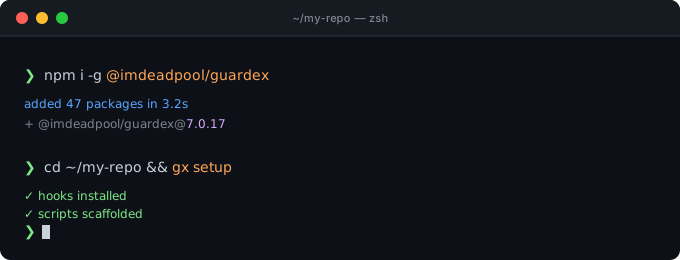
npm i -g @imdeadpool/guardex
Then cd into your repo and run gx setup — hook shims, repo state,
and OMX / OpenSpec / caveman wiring all scaffold in one go.
guard many agent. keep one repo clean.
Guardian T-Rex for your multi-agent repo. Isolated worktrees, file locks, and PR-only merges stop parallel Codex & Claude agents from overwriting each other's work. Auto-wires Oh My Codex, Oh My Claude, OpenSpec, and Caveman.
Guardian T-Rex for your multi-agent repo. Isolated worktrees, file locks, and PR-only merges stop parallel Codex & Claude agents from overwriting each other's work. Auto-wires Oh My Codex, Oh My Claude, OpenSpec, and Caveman.
Warning
Not affiliated with OpenAI, Anthropic, or Codex. Not an official tool.
Important
GitGuardex is still being tested in real multi-agent repos. If something feels rough or broken, especially around cleanup, finish, merge, or recovery flows, sorry. We need to test those paths under real load first, and we'll patch issues as we find them.
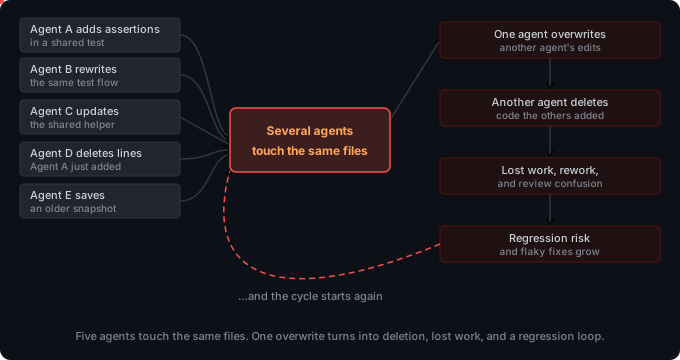
I was running ~30 Codex agents in parallel and hit a wall: they kept working on the same files at the same time — especially tests — and started overwriting or deleting each other's changes. More agents meant less forward progress, not more. Classic de-progressive loop.
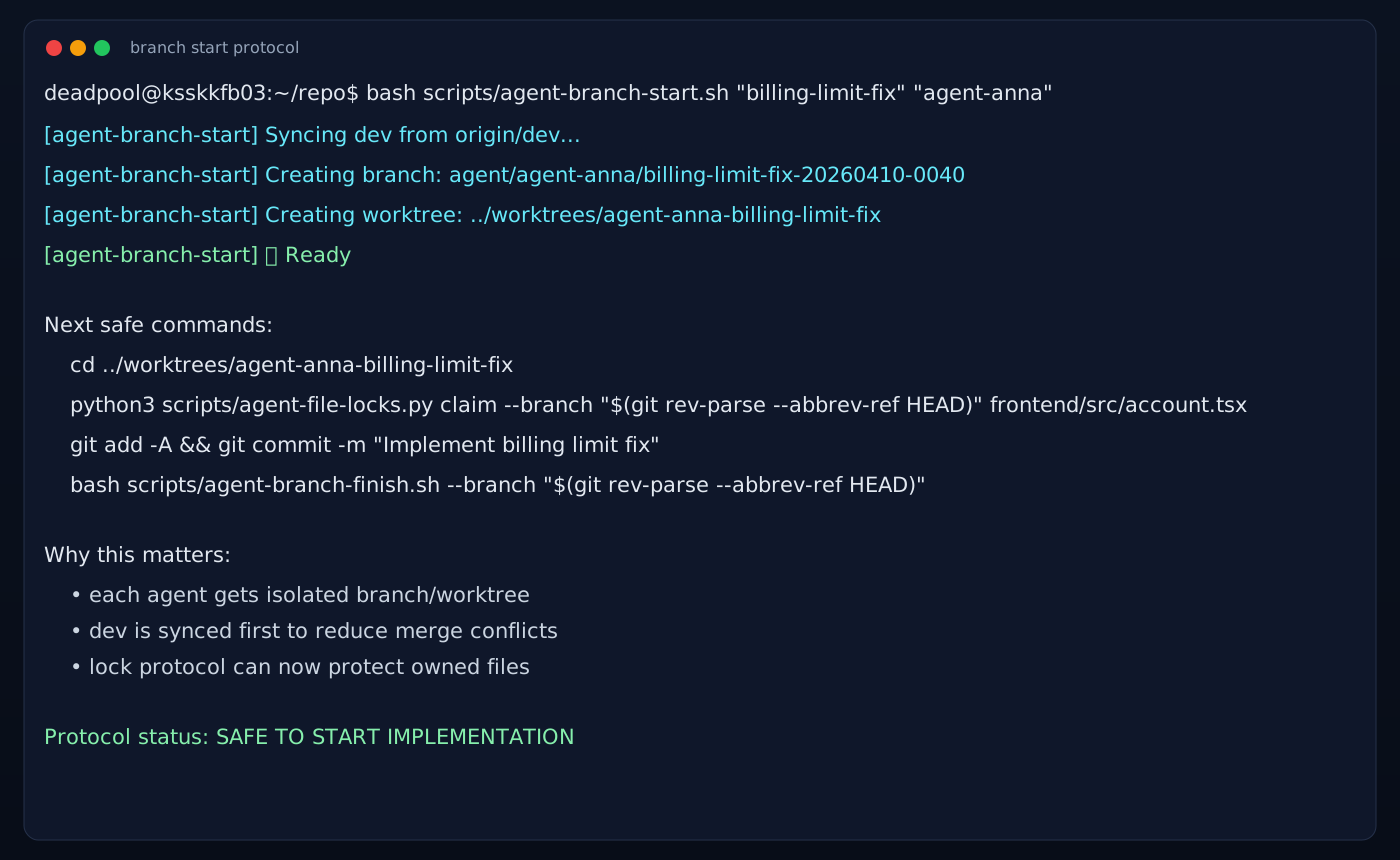
GitGuardex exists to stop that loop. Every agent gets its own worktree, claims the files it's touching, and can't clobber files another agent has claimed. Your local branch stays clean; agents stay in their lanes.
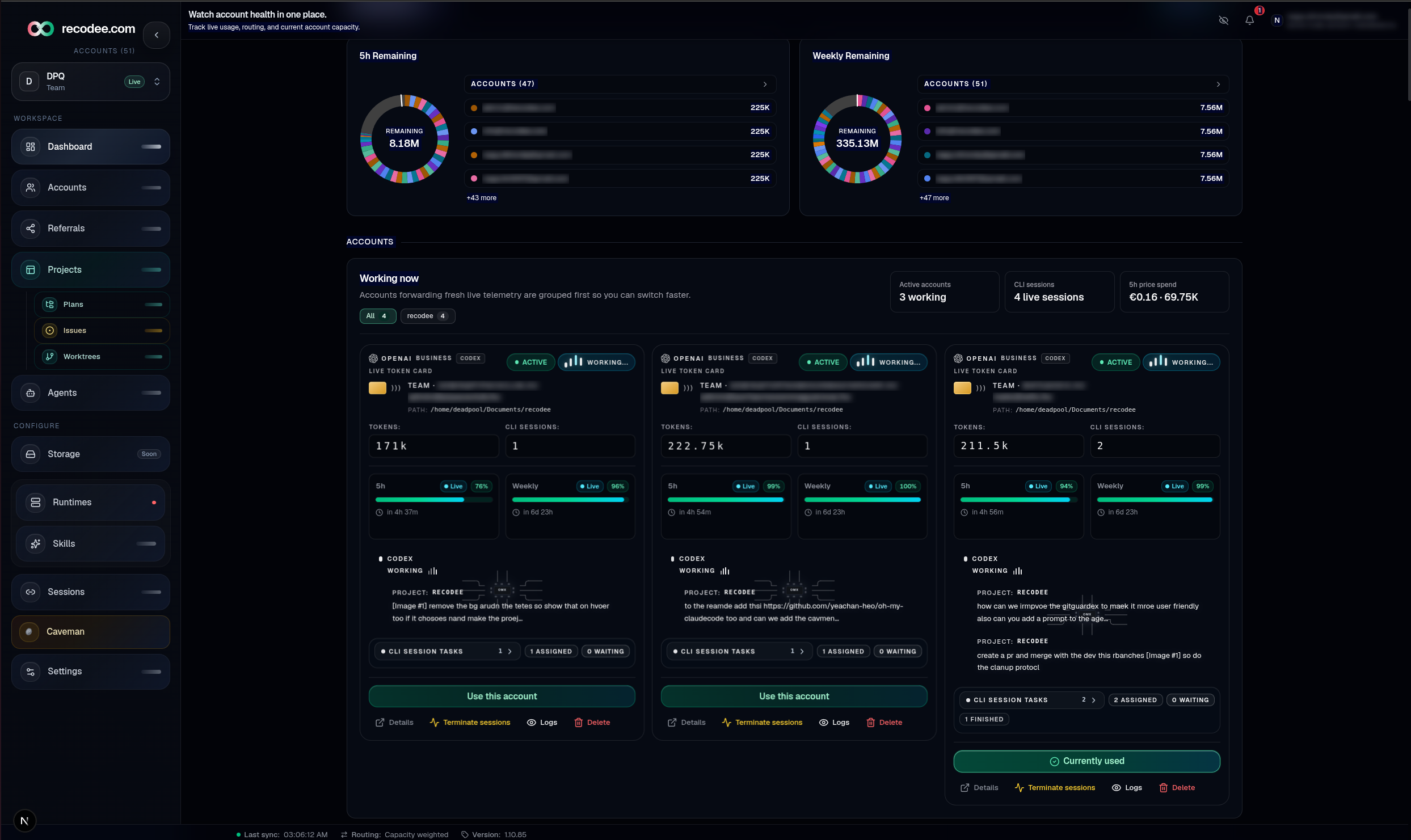
Coming soon: recodee.com — live account health, usage, routing, and capacity in one place.
- Isolated
agent/*branch + worktree per task — agents never share a working directory. - Explicit file lock claiming — an agent declares which files it's editing before it edits them.
- Deletion guard — claimed files can't be removed by another agent.
- Protected-base safety —
main,dev,masterare blocked by default; agents must go through PRs. - Auto-merges agent configs into every worktree —
oh-my-codex,oh-my-claudecode, caveman mode, and OpenSpec all get applied automatically so every spawned agent starts tuned, not bare. - Repair/doctor flow — when drift happens (and it will),
gx doctorgets you back to a clean state. - Auto-finish — when Codex exits a session, GitGuardex commits sandbox changes, syncs against the base, retries once if the base moved, and opens a PR.
npm i -g @imdeadpool/guardex
cd /path/to/your/repo
gx setup
That's it. Install and update via @imdeadpool/guardex. Setup installs the minimal repo footprint: managed hook shims, repo-local state, AGENTS wiring, OpenSpec/caveman/OMX scaffolding, and a small set of repo-local helper assets. Aliases: gx (preferred), gitguardex (full), guardex (legacy compatibility).
Important
GitGuardex never overwrites your guidance. Only the content between these markers is managed:
<!-- multiagent-safety:START -->
  ... managed content ...
<!-- multiagent-safety:END -->
Everything outside that block is preserved byte-for-byte.
| Your repo has… | gx setup / gx doctor does… |
|---|---|
AGENTS.md with markers |
Refreshes only the managed block |
AGENTS.md without markers |
Appends the managed block to the end |
No AGENTS.md |
Creates it with the managed block |
A root CLAUDE.md |
Leaves it alone |
Note
In this repo, CLAUDE.md is a symlink to AGENTS.md, so Claude reads the same contract. Optional Codex/Claude companion files are installed at the user level with gx install-agent-skills, not copied into each repo.
flowchart TD
    Start([gx setup / gx doctor])
    Check{AGENTS.md<br/>exists?}
    Markers{Markers<br/>present?}
    Create[Create AGENTS.md<br/>with managed block]
    Refresh[Refresh the<br/>managed block]
    Append[Append managed block<br/>to end of file]
    Done([Repo-owned text preserved])

    Start --> Check
    Check -- No --> Create
    Check -- Yes --> Markers
    Markers -- Yes --> Refresh
    Markers -- No --> Append
    Create --> Done
    Refresh --> Done
    Append --> Done

    classDef entry   fill:#0b76c5,stroke:#60a5fa,stroke-width:2px,color:#fff
    classDef decide  fill:#78350f,stroke:#fbbf24,stroke-width:2px,color:#fff
    classDef action  fill:#374151,stroke:#94a3b8,stroke-width:1.5px,color:#f1f5f9
    classDef finish  fill:#064e3b,stroke:#34d399,stroke-width:2px,color:#fff

    class Start entry
    class Check,Markers decide
    class Create,Refresh,Append action
    class Done finish
  # AGENTS

  Project-specific guidance before managed block.

  <!-- multiagent-safety:START -->
- - old managed contract
+ - current GitGuardex-managed contract
  <!-- multiagent-safety:END -->

  Trailing repo notes after managed block.
Only lines inside the marker block change. Everything above and below is preserved exactly.
Before you branch, repair, or start agents, run plain gx. It gives you a one-screen status view for the CLI, global helpers, repo safety service, current repo path, and active branch.
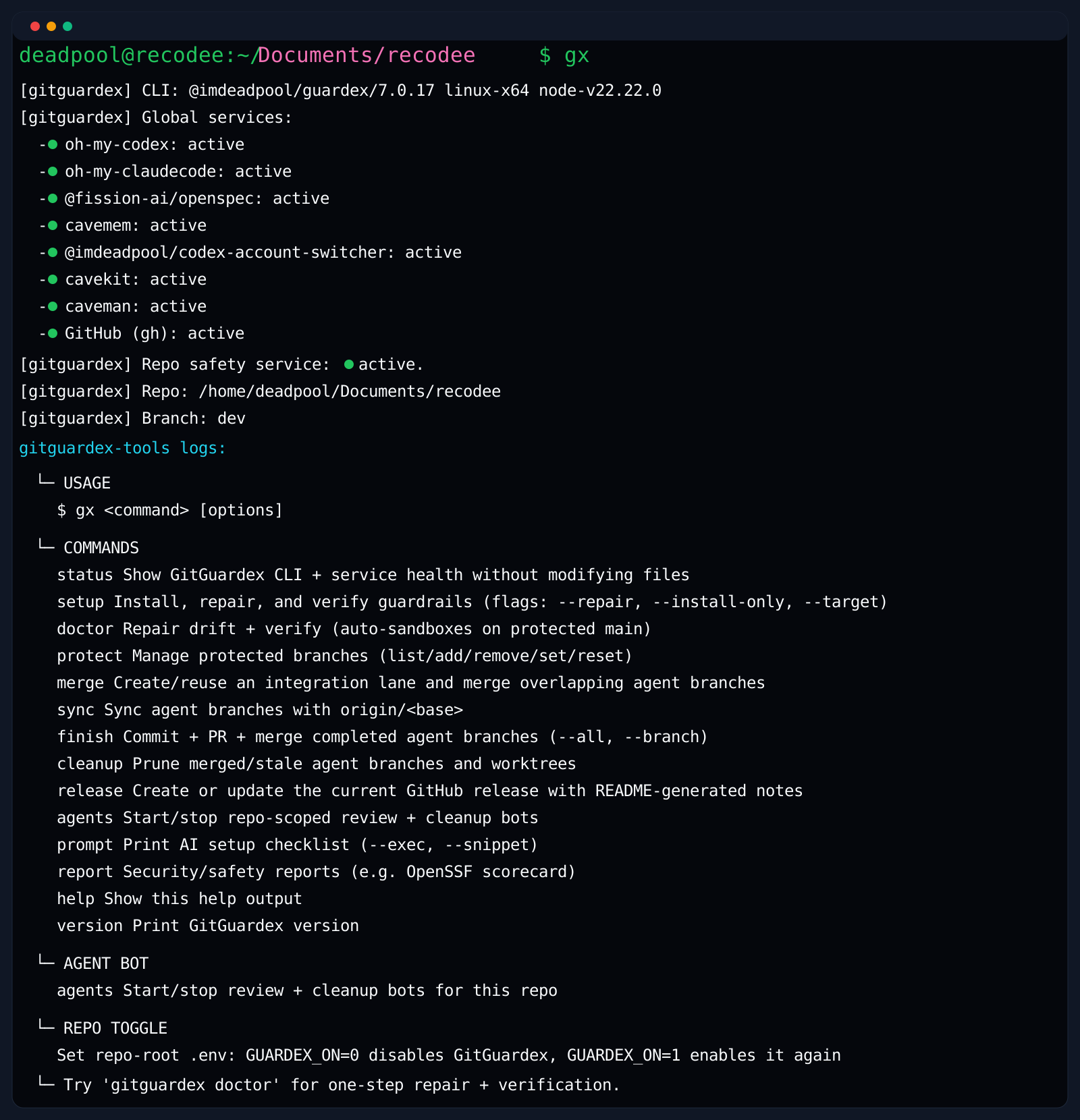
Use gx setup the first time you wire GitGuardex into a repo. It bootstraps the managed hook shims, repo-local state, and optional workspace/OpenSpec wiring. If the repo drifts later, use gx doctor as the repair path: it reapplies the managed safety files, verifies the setup, and on protected main it auto-sandboxes the repair so your visible base branch stays clean.
Per new agent task:
# 1) Start isolated branch/worktree
gx branch start "task-name" "agent-name"

# 2) Claim the files you're going to touch
gx locks claim \
  --branch "$(git rev-parse --abbrev-ref HEAD)" <file...>

# 3) Implement + verify
npm test

# 4) Finish (commit + push + PR + merge + cleanup)
gx branch finish \
  --branch "$(git rev-parse --abbrev-ref HEAD)" \
  --base main --via-pr --wait-for-merge --cleanup
If you launch Codex through Guardex, the finish flow runs automatically when the Codex session exits — it auto-commits, retries once after syncing if the base moved during the run, then pushes and opens the PR.
GitGuardex normally prunes merged sandboxes for you as part of the finish flow. If you simply do not want a local sandbox/worktree anymore, remove that worktree directly; delete the branch too only if you are intentionally abandoning that lane:
git worktree remove .omx/agent-worktrees/<worktree-name>
# Claude Code sandboxes live under .omc/agent-worktrees/<worktree-name>
git branch -D agent/<role>/<task>   # optional, only if you are discarding the lane
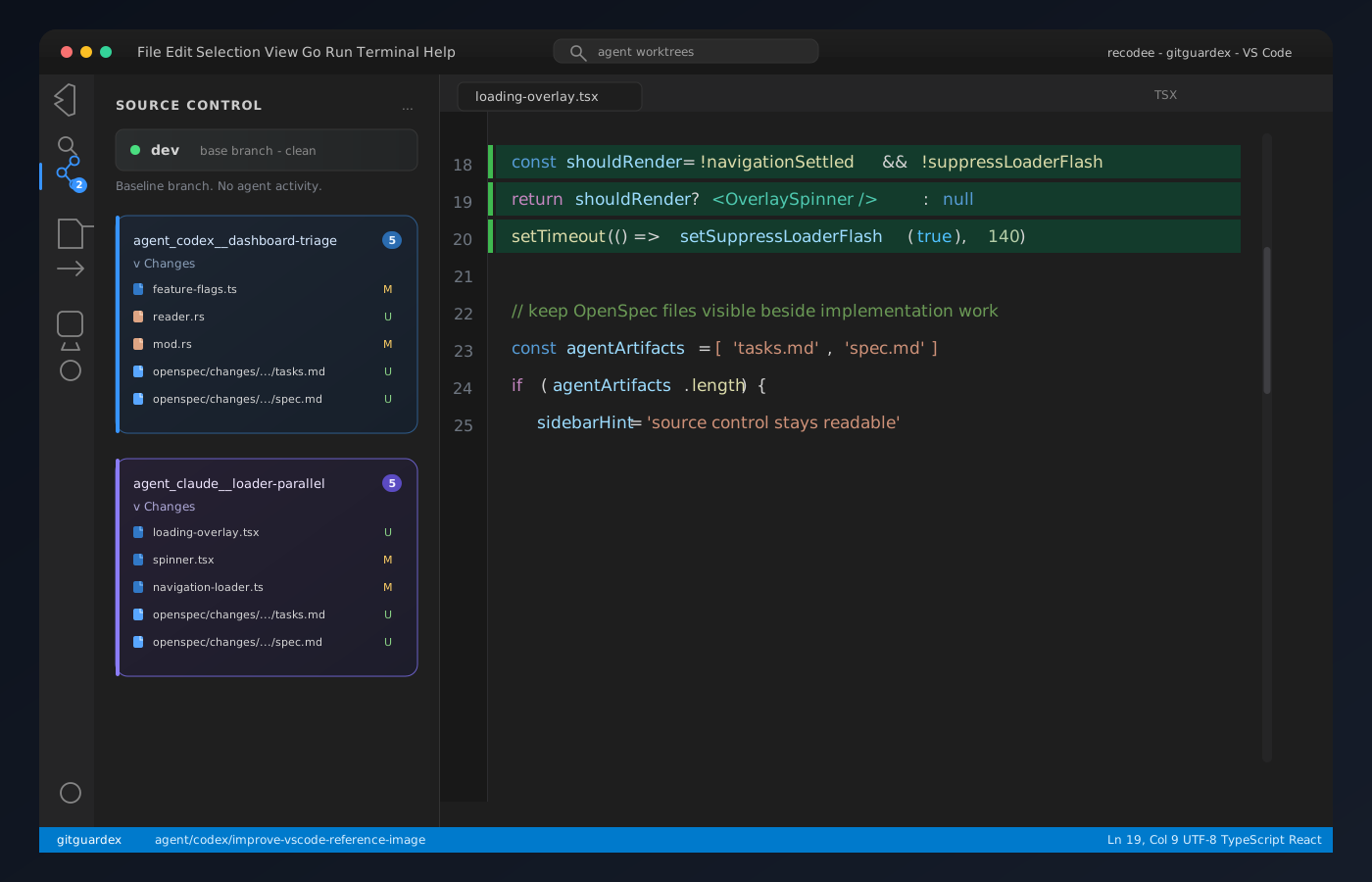
Running Codex across several existing worktrees (e.g. from VS Code Source Control)? Finalize everything ready at once:
gx finish --allCodex sessions default to .omx/agent-worktrees/. Claude Code sessions default to .omc/agent-worktrees/, so Claude sandboxes stay under the Claude runtime folder instead of sharing the Codex root.
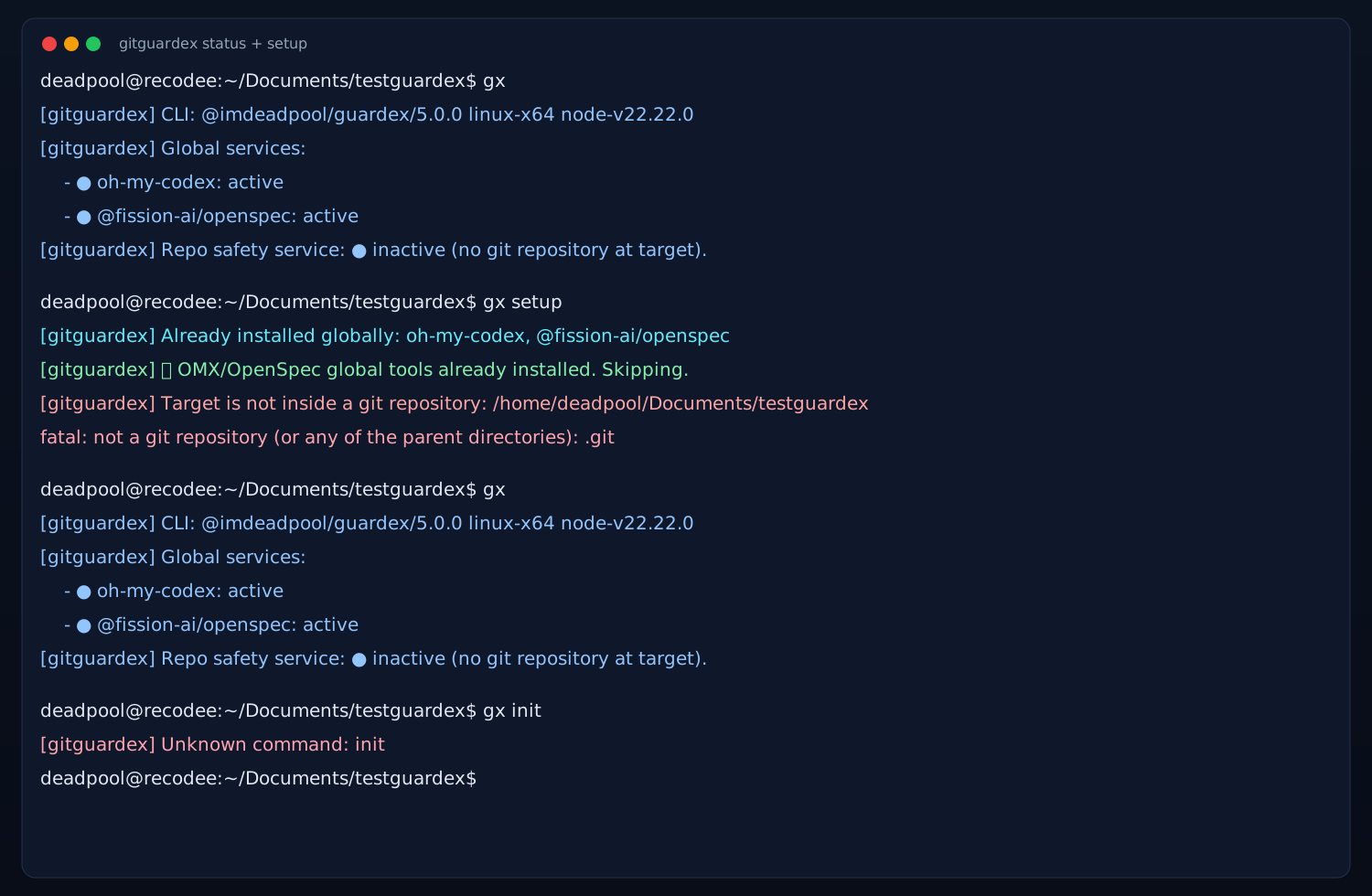 |
gx setup — bootstraps everything in one command |
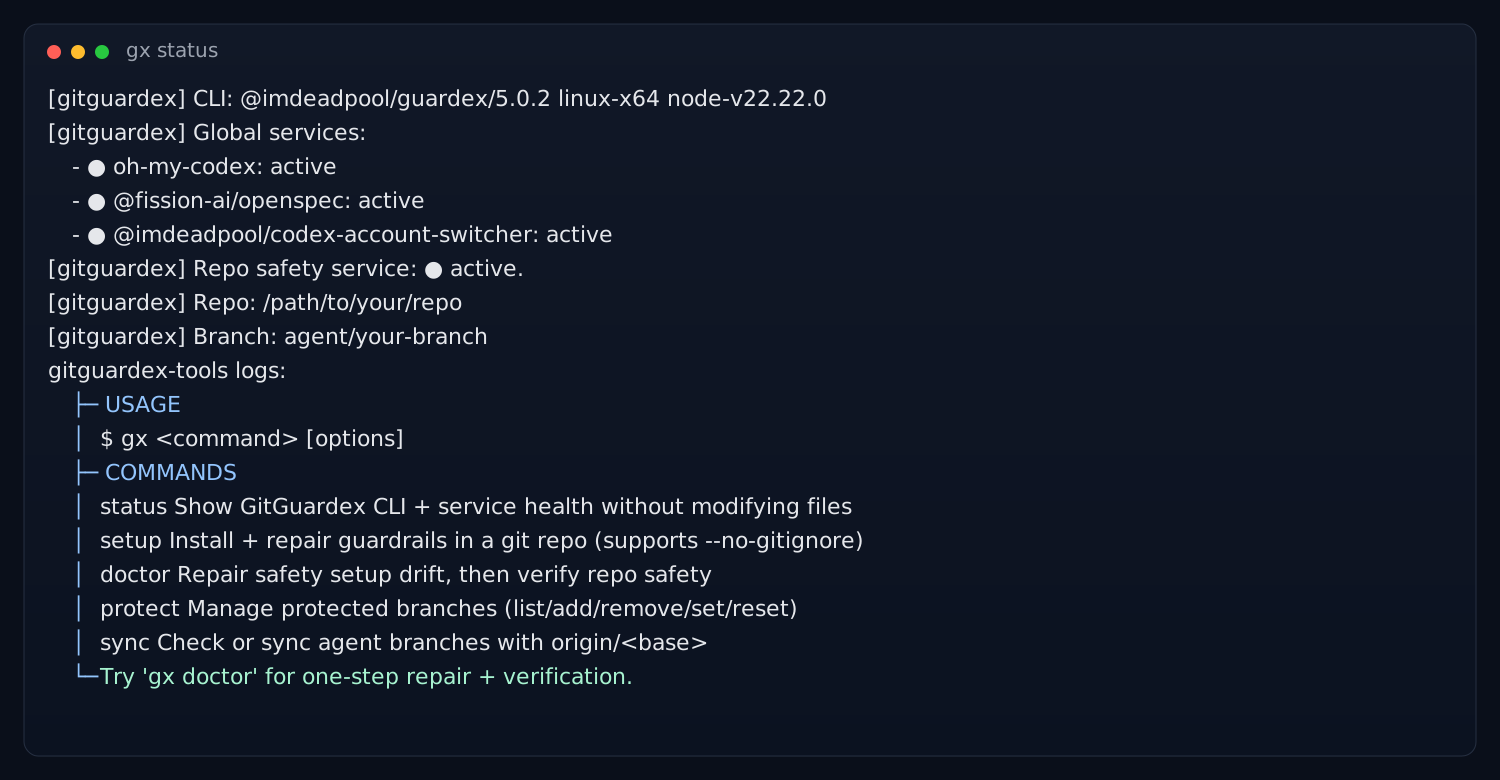 |
gx status — health check for tools, hooks, services |
|
Branch/worktree start protocol |
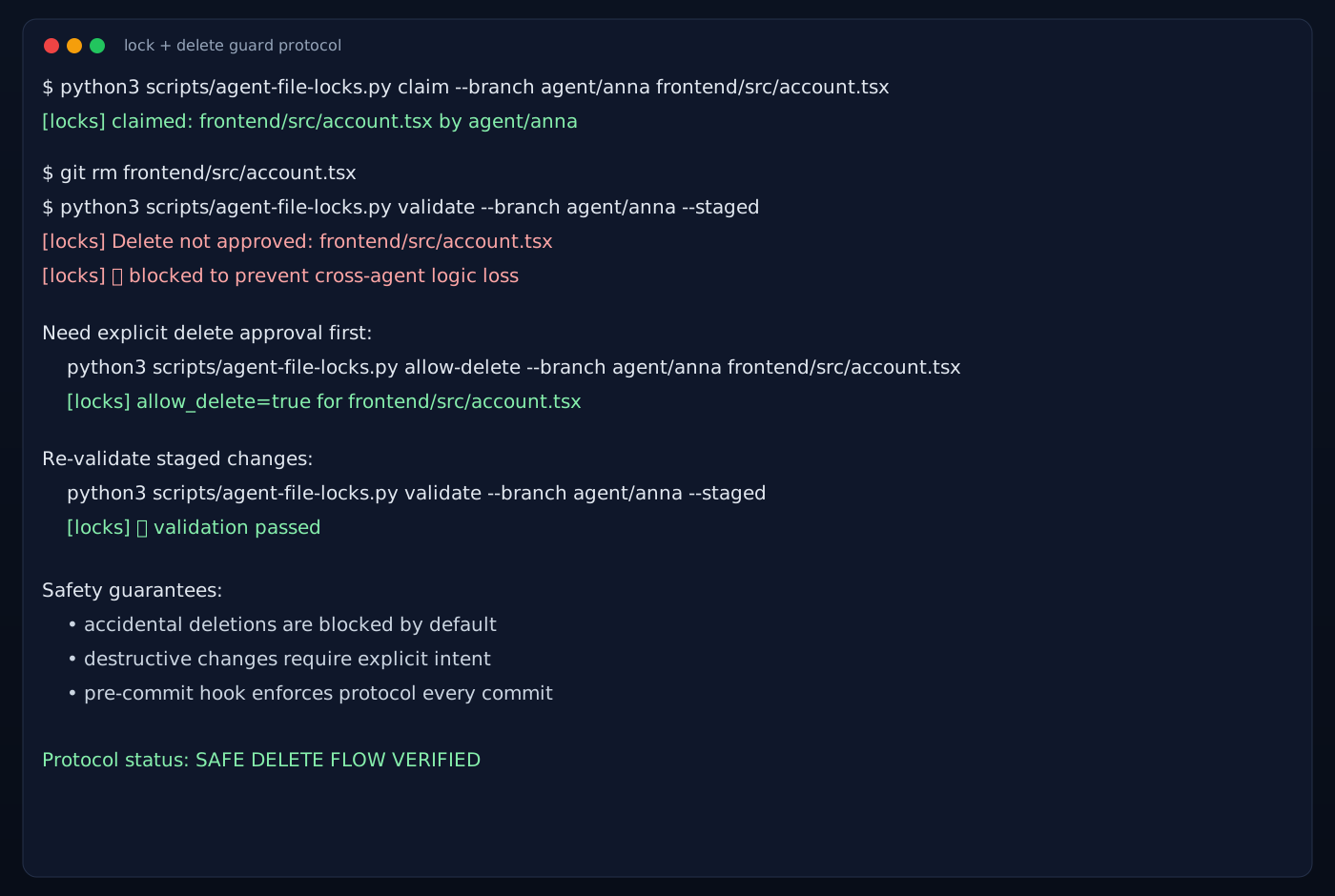 |
Lock + delete-guard protocol |
 |
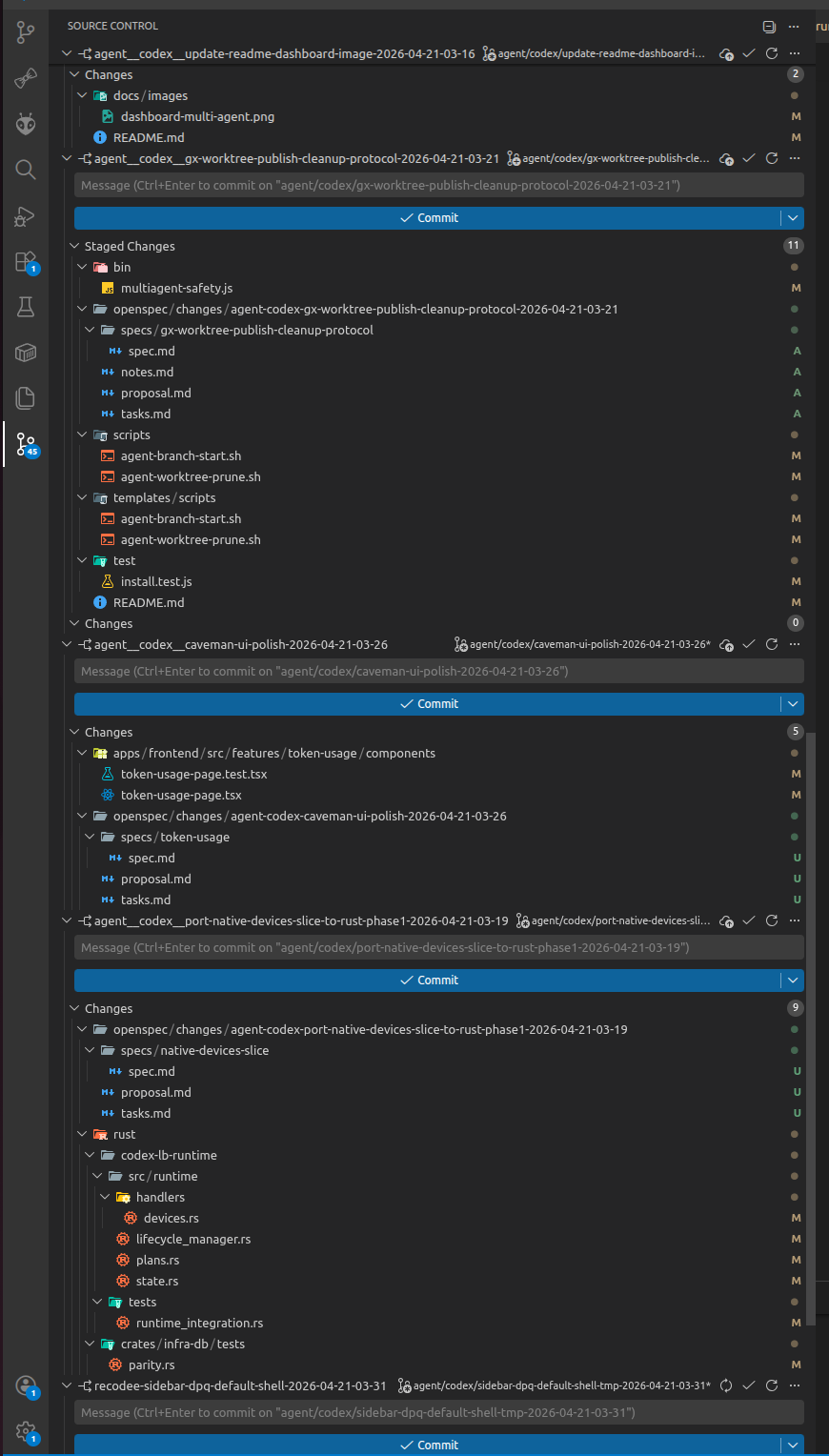
VS Code Source Control view with agent + OpenSpec files |
This is the real Source Control shape GitGuardex is aiming for: isolated agent branches, clear OpenSpec artifacts, and no pile-up on one shared checkout.
To install the real companion into local VS Code from a GitGuardex-wired repo:
node scripts/install-vscode-active-agents-extension.jsIt adds an Active Agents view to the Source Control container, groups each live repo into ACTIVE AGENTS and CHANGES sections, splits ACTIVE AGENTS into BLOCKED, WORKING NOW, IDLE, STALLED, and DEAD when those states are present, mirrors the selected session or active-agent count in the VS Code status bar, reads .omx/state/active-sessions/*.json, derives session state from git conflict markers, dirty worktree status, PID liveness, and recent file mtimes, and surfaces working/dead counts in the repo/header affordances. Reload the VS Code window after install.
gx status                 # health check (default)
gx status --strict        # exit non-zero on findings
gx setup                  # full bootstrap
gx setup --repair         # repair only
gx setup --install-only   # scaffold templates, skip global installs
gx doctor # repair + verify (auto-sandboxes on protected main)gx setup --target /path/to/repo
gx doctor --target /path/to/repo
# optional: VS Code workspace showing repo + agent worktrees
gx setup --target /path/to/repo --parent-workspace-viewSetup auto-installs into every nested git repo (e.g. apps/*/.git). Submodules and worktrees under .omx/agent-worktrees/ or .omc/agent-worktrees/ are skipped.
gx setup --target /mainfolder
gx setup --target /mainfolder --no-recursive
gx setup --target /mainfolder --current
gx doctor --target /mainfolder --currentOn a brand-new repo, gx setup now prints the next real steps too: commit the scaffold, start the first agent branch, and add origin if you want finish/merge flows to leave the machine.
If the repo already has docker-compose.yml, docker-compose.yaml, compose.yml, or compose.yaml, setup also points you at the bundled Docker loader:
GUARDEX_DOCKER_SERVICE=app bash scripts/guardex-docker-loader.sh -- npm testWhen the service is already running, the loader uses docker compose exec; otherwise it falls back to docker compose run --rm.
gx protect list
gx protect add release staging
gx protect remove release
gx protect set main release hotfix
gx protect reset
Defaults: dev, main, master. Stored in git config key multiagent.protectedBranches.
gx sync --check
gx syncgx agents start # review monitor + stale cleanup
gx agents stop
gx agents stop --pid 12345
gx agents status
# tuning
gx agents start --review-interval 30 --cleanup-interval 60 --idle-minutes 10gx finish --all # commit + PR + merge every ready agent/* branch
gx cleanup # prune merged/stale branches and worktrees
gx cleanup --watch --interval 60
gx cleanup --idle-minutes 10
gx cleanup --watch --once --interval 60
gx release # create/update the current GitHub release from README notesgx release is the maintainer path for package releases. It reads the versioned sections under README.md -> Release notes, finds the last published GitHub release, and writes one grouped GitHub release body covering everything newer than that release and up to the current package version.
That GitHub release then triggers .github/workflows/release.yml, which performs the actual npm publish --provenance --access public step.
gx prompt                 # full checklist (paste into Codex/Claude)
gx prompt --exec          # commands only
gx prompt --part task-loop
gx prompt --exec --part finish --part cleanup
gx prompt --list-parts
gx prompt --snippet # AGENTS.md managed-block templategx report scorecard --repo github.com/recodeee/gitguardexFive commands were consolidated into flags. Old names still work and print a deprecation notice; they'll be removed in v8.
| v6 | v7 |
|---|---|
gx init |
gx setup |
gx install |
gx setup --install-only |
gx fix |
gx setup --repair |
gx scan |
gx status --strict |
gx copy-prompt |
gx prompt |
gx copy-commands |
gx prompt --exec |
gx print-agents-snippet |
gx prompt --snippet |
gx review |
gx agents start |
A few things worth knowing up front:
- Running
gxwith no command opens the status/health view. gx initis just an alias forgx setup.- Setup/doctor can install missing companion tooling (OMC runtime, OpenSpec, cavemem, codex-auth, caveman, cavekit) — but only with explicit Y/N confirmation.
- Direct commits/pushes to protected branches are blocked by default. Agents must use the
agent/*+ PR flow. - Exception: VS Code Source Control commits are allowed on protected branches that exist only locally (no upstream, no remote branch).
- On protected
main,gx doctorauto-runs in a sandbox agent branch/worktree so it can't touch your real main. - In-place agent branching is disabled.
gx branch startalways creates a separate worktree so your visible local/base branch never changes. - Fresh sandbox branches start with no git upstream. Guardex records the protected base in
branch.<name>.guardexBase, and the firstgit push -upublishes the real upstream. - Interactive self-update prompt defaults to No (
[y/N]).
Optional override for manual VS Code protected-branch writes:
git config multiagent.allowVscodeProtectedBranchWrites trueGitGuardex is designed to work alongside these. All optional — but if you're running many agents, you probably want them. gx status reports the machine-detectable companion helpers, including local caveman / cavekit installs when their home-directory footprints are present.
● oh-my-codex: active
● oh-my-claude-sisyphus: active
● @fission-ai/openspec: active
● cavemem: active
● cavekit: active
● caveman: active
● @imdeadpool/codex-account-switcher: active
● gh: active
Loads skills, slash commands, and session defaults into Codex. GitGuardex merges oh-my-codex into every agent worktree automatically, so every spawned agent starts with the same tuned config instead of vanilla Codex.
npm i -g oh-my-codexRepo: https://github.com/Yeachan-Heo/oh-my-codex

Claude-side mirror of oh-my-codex. Same idea: skills, commands, and defaults loaded into every Claude Code session. GitGuardex merges it into worktrees alongside oh-my-codex so mixed Codex + Claude agent fleets behave consistently. For the npm CLI/runtime path, the published package name is oh-my-claude-sisyphus.
npm i -g oh-my-claude-sisyphus@latestRepo: https://github.com/Yeachan-Heo/oh-my-claudecode

Ultra-compressed response mode for Claude/Codex-style agents. Useful when you want less output-token churn during long reviews, debug loops, or multi-agent sessions.
npx skills add JuliusBrussee/cavemanRepo: https://github.com/JuliusBrussee/caveman

Cross-agent memory with local SQLite + MCP. Helpful when you want Codex or Claude sessions to retain compressed history across runs. gx setup can install the CLI; you still run the IDE wiring once per machine.
npm install -g cavemem
cavemem install --ide codex
cavemem status
Repo: https://github.com/JuliusBrussee/cavemem

Spec-driven workflow layer for building from durable specs with explicit build/check commands. The current install path also brings in its spec, build, check, caveman, and backprop skills.
npx skills add JuliusBrussee/cavekitRepo: https://github.com/JuliusBrussee/cavekit

Structured plan/change/apply/archive flow for agents. Prevents them from drifting off-task on long jobs. Full guide: docs/openspec-getting-started.md.
npm i -g @fission-ai/openspecRepo: https://github.com/Fission-AI/OpenSpec

For multi-identity Codex workflows. I built this because switching accounts manually for 30 agents was impossible. Auto-registers accounts to a dashboard on codex login so you can see every account and switch with one command.
npm i -g @imdeadpool/codex-account-switcher

codex-auth save <name>
codex-auth use <name>
codex-auth list --details
codex-auth current
Repo: recodeecom/codex-account-switcher-cli

Required for PR/merge automation. agent-branch-finish.sh and codex-agent.sh auto-finish both depend on it.
# https://cli.github.com/
gh --version
gh auth statusGuardex installs a starter config at .github/pull.yml.example.
cp .github/pull.yml.example .github/pull.yml
# edit rules[].base and rules[].upstream
Install the app: https://github.com/apps/pull
Validate: https://pull.git.ci/check/<owner>/<repo>
Install: https://github.com/apps/cr-gpt
gx setup installs .github/workflows/cr.yml. Add OPENAI_API_KEY under Settings → Secrets and variables → Actions → Secrets. After that, new and updated PRs get reviewed automatically.
If you installed OpenSpec during setup (@fission-ai/openspec), the full guide is at docs/openspec-getting-started.md.
Default flow:
/opsx:propose <change-name> → /opsx:apply → /opsx:archive
Expanded flow:
/opsx:new <change-name> → /opsx:ff or /opsx:continue → /opsx:apply → /opsx:verify → /opsx:archive
- The Guardex Codex launcher enforces OpenSpec workspaces before launching Codex.
gx branch startcan scaffold bothopenspec/changes/<slug>/andopenspec/plan/<slug>/whenGUARDEX_OPENSPEC_AUTO_INIT=true.- The collaboration section in
tasks.mdis there for real cleanup handoffs too. If the first Codex/Claude session finishes the implementation work but hits a usage limit beforeagent-branch-finish --cleanup, hand the same sandbox to another agent, let that agent finish cleanup, and record the join/handoff in the change task.
Environment variables:
| Var | Purpose |
|---|---|
GUARDEX_OPENSPEC_AUTO_INIT |
true to auto-bootstrap on branch start (default false) |
GUARDEX_OPENSPEC_PLAN_SLUG |
force a specific plan workspace name |
GUARDEX_OPENSPEC_CHANGE_SLUG |
force a specific change workspace name |
GUARDEX_OPENSPEC_CAPABILITY_SLUG |
override capability folder for spec.md scaffolding |
AGENTS.md                   # managed multi-agent block appended/refreshed in place
.githooks/pre-commit        # shim -> gx hook run pre-commit
.githooks/pre-push          # shim -> gx hook run pre-push
.githooks/post-merge        # shim -> gx hook run post-merge
.githooks/post-checkout     # shim -> gx hook run post-checkout
scripts/guardex-env.sh      # repo toggle + hook/helper env bridge
scripts/guardex-docker-loader.sh       # compose env/loader helper
scripts/agent-session-state.js         # active-session state helper
scripts/install-vscode-active-agents-extension.js
.omc/agent-worktrees        # Claude sandbox root
.omx/agent-worktrees        # Codex sandbox root
.omx/state/agent-file-locks.json       # file-lock registry
.github/pull.yml.example
.github/workflows/cr.yml
vscode/guardex-active-agents/package.json
vscode/guardex-active-agents/extension.js
vscode/guardex-active-agents/session-schema.js
vscode/guardex-active-agents/README.md
Legacy compatibility note: older repos may still contain repo-local workflow scripts under scripts/. Direct gx branch ..., gx locks ..., gx finish, gx cleanup, gx merge, and gx migrate do not require them. gx migrate removes those leftover workflow shims by default. The CLI still honors repo-local scripts/review-bot-watch.sh and scripts/codex-agent.sh when they are already present so older repos can keep working during migration.
Optional Codex/Claude user-level companions still install with gx install-agent-skills; they are not copied into each repo.
- Standalone frontend repo: https://github.com/recodeee/gitguardex-frontend
- This repo tracks the frontend under
frontend/and auto-mirrors it via.github/workflows/sync-frontend-mirror.ymlon changes tomain.
Setup (in this repo):
Settings → Secrets and variables → Actions- Add secret
GUARDEX_FRONTEND_MIRROR_PATwithcontents:writeonrecodeee/gitguardex-frontend
Optional overrides (Actions Variables):
GUARDEX_FRONTEND_MIRROR_REPO(defaultrecodeee/gitguardex-frontend)GUARDEX_FRONTEND_MIRROR_BRANCH(defaultmain)
Manual run:
gh workflow run sync-frontend-mirror.ymlBeing honest about where this still has issues:
- Usage limit mid-task. When an agent hits its Codex/Claude usage limit partway through, another agent may need to take over the same sandbox and run the remaining finish/cleanup steps. The OpenSpec collaboration checklist is there to capture that handoff, but it is still uglier than I'd like.
- Conflict-stuck probes. Fixed in v7.0.2 — earlier versions could leak
__source-probe-*worktrees when the sync-guard rebase hit conflicts. If you're on an older release,gx cleanupsweeps these. - Windows. Most of the hook surface assumes a POSIX shell. Use WSL or symlink-enabled git if you're on Windows.
PRs and issues welcome.
- CI matrix on Node 18 / 20 / 22 (
npm test,node --check,npm pack --dry-run) - Trusted publishing with provenance via GitHub Actions
- OpenSSF Scorecard + Dependabot for Actions
- Disclosure policy in
SECURITY.md
npm test
node --check bin/multiagent-safety.js
npm pack --dry-runv7.x
- Bumped
@imdeadpool/guardexfrom7.0.24to7.0.25so npm and GitHub Releases can ship the currentmainpayload. - The bundled
GitGuardex Active AgentsVS Code companion now self-heals stale repo-scan ignore settings in older repos, keeps plain managed sandboxes visible in Source Control, and preserves cleanup truth so the tree matches actual sandbox state. - Bumped the shipped Active Agents companion manifests from
0.0.8to0.0.9so local VS Code installs can pick up the newer workspace build and show the refreshed extension version from this release.
- Bumped
@imdeadpool/guardexfrom7.0.23to7.0.24so GitHub Releases and the npm publish retry can advance together afterv7.0.23landed on GitHub but not on npm. - Release verification no longer loses its base ref on tag-triggered runs, so the publish workflow keeps the history it needs before packing and publish checks.
- Keep the release scoped to version and release automation metadata only; the packaged Guardex CLI payload stays aligned with the already-verified
mainbranch contents.
- Bumped
@imdeadpool/guardexfrom7.0.22to7.0.23so GitHub release and npm can advance together after7.0.22reached npm without a matching published GitHub release. - Active Agents stays easier to scan and more truthful: the package repo remains the canonical source, inspect/install paths stay loadable across VS Code churn, and session rows group under worktrees with clearer merged-cleanup truth.
- Guardex prompt and finish guidance now pushes faster phase-based execution, keeps helper behavior single-sourced, and avoids fragmented probe loops when cleanup or branch-deletion races appear.
- Bumped
@imdeadpool/guardexfrom7.0.21to7.0.22so npm can publish the next release from the current merged mainline. - The shipped
mainpayload already includes lower-token prompt slices, SCM-selected lane visibility, truthful merged-cleanup evidence, the Active Agents brand/icon refresh, and the remaining CLI extraction cleanups without changing Guardex behavior. - Keep the release scoped to version and release metadata only; the package payload stays the same as the verified
mainbranch contents.
- Bumped
@imdeadpool/guardexfrom7.0.20to7.0.21so npm can publish the next release from the current merged mainline. - Keep the release scoped to version and release metadata only; the package payload stays the same as the verified
mainbranch contents. - Published-release automation will pick up this new package version once the matching GitHub release is created.
- The VS Code Active Agents tree now exposes worktree-owned SCM changes and lock ownership directly, so operators can see which sandbox owns a dirty file before they act.
- Guardex now keeps merged cleanup evidence truthful by recording final cleanup proof only after the merge and cleanup state is actually available.
- Install-surface verification cleanup on
mainis easier to maintain without changing the shipped CLI surface. - Bumped the release from
7.0.19→7.0.20so the shipped Active Agents visibility and cleanup-evidence refinements land on a fresh publishable npm version.
gx setupandgx doctornow accept targeted managed-file recovery after--force, sogx doctor --force scripts/review-bot-watch.shrepairs the named managed file instead of failing on an unknown argument.- Managed-file conflict output now teaches both recovery forms directly:
--force <managed-path>for one file and plain--forcefor whole-surface rewrites. - GitGuardex now keeps small-task routing caveman-only by default and makes working VS Code agent lanes easier to spot at a glance while keeping the CLI-owned install-surface rollout intact.
- Bumped the release from
7.0.18→7.0.19so the shipped setup/doctor recovery and UX refinements land on a fresh publishable npm version.
- GitGuardex now keeps the install workflow in
gxitself:gx branch ...,gx locks ...,gx worktree prune,gx migrate, and user-level agent-skill install now own the agent lifecycle instead of teaching pasted repo scripts as the primary surface. - Fresh installs switch repo hooks to tiny
gx hook run ...shims, stop copying repo-local workflow implementations and repo-local skills, and stop injecting Guardex-managedagent:*package scripts into consumer repos. gx migratecan move older repos onto the smaller CLI-owned install surface while preserving the managed AGENTS block, lock registry state, hook shims, required gitignore entries, and the repo-local helper assets that still carry local state.- Bumped the release from
7.0.17→7.0.18so the shipped CLI-owned install-surface changes land on a fresh publishable npm version.
- Restored the published npm package name to
@imdeadpool/guardexafter the@imdeadpool/gitguardexrename only changed the package identity locally and could not rename the existing npm registry entry. - README/install/tutorial/self-update surfaces now point back at
@imdeadpool/guardexwhile keeping GitGuardex as the product/repo brand andgitguardexas the long-form command. - Bumped the release from
7.0.16→7.0.17because@imdeadpool/guardex@7.0.16is already published on npm.
- GitGuardex now publishes under the matching npm package name
@imdeadpool/gitguardex, and install/help/docs surfaces point at the renamed package instead of the older@imdeadpool/guardexscope. gx doctornow keeps nested repo repair runs visibly progressing, and overlapping integration work stays off the protected base branch instead of trying to merge back onmain.- Cleanup and finish flows are less brittle:
codex-agentno longer waits on PRs that can never exist, and prune cleanup now walks both managed worktree roots so stale sandboxes get removed consistently. - Mirror-sync diagnostics are quieter: when the mirror PAT is unset, GitGuardex now skips the sync path instead of marking the run red, and shared
ralplanlanes stay easier to identify during handoff/debugging. - Bumped the release from
7.0.15→7.0.16after npm rejected a republish of7.0.15.
gx doctorno longer blocks recursive nested protected-repo repairs on child PR merge waits; nested sandboxes now force--no-wait-for-mergeso the parent repair loop can continue.gx setupcan now refresh managed files from protectedmainthrough a temporary sandbox branch/worktree, sync the managed outputs back to the visible base checkout, and prune the sandbox afterward.- Bumped
@imdeadpool/guardexfrom7.0.14→7.0.15after npm rejected a republish over the already-published7.0.14.
- Bumped
@imdeadpool/guardexfrom7.0.13→7.0.14after npm rejected a republish over the already-published7.0.13. - No package payload changes beyond the release metadata bump; this release exists so
npm publishcan proceed with a fresh semver.
gx statusandgx setupnow present the Claude companion asoh-my-claudecodewhile still installing the published npm packageoh-my-claude-sisyphus.- When that dependency is inactive or the user declines the optional install, GitGuardex now prints the upstream repo URL so the missing dependency is explicit instead of hidden behind the npm package name.
- Bumped
@imdeadpool/guardexfrom7.0.12→7.0.13after npm rejected a republish over the already-published7.0.12.
- Fixed the self-update handoff after
gxinstalls a newer global package. When the on-disk install advances, GitGuardex now restarts into the installed CLI instead of continuing in the old process and printing the stale in-memory version. - This removes the confusing
Updated to latest published versionfollowed byCLI: ...7.0.10mismatch that happened when7.0.11finished installing during the samegxinvocation. - Bumped
@imdeadpool/guardexfrom7.0.11→7.0.12.
- Fixed the npm release workflow trigger so publishes run from
release.publishedor explicit manual dispatch, instead of double-firing on both the tag push and the release event. - This keeps the GitHub
npmenvironment from collecting duplicate cancelled deploy cards for the same version and leaves one canonical release deployment to monitor. - Bumped
@imdeadpool/guardexfrom7.0.10→7.0.11so the next release can publish cleanly after7.0.10was already taken on npm.
- Primary user-facing long name is now GitGuardex. CLI/help presents
gitguardexas the long-form command;gxstays the preferred short alias;guardexremains as legacy compatibility. - Installed Codex/Claude startup files now use
gitguardexpaths:.codex/skills/gitguardex/SKILL.mdand.claude/commands/gitguardex.md. - Startup context shrunk further. Managed marker block + skill + command compressed from 4340 B → 1930 B across the three always-loaded template files.
- Bumped
@imdeadpool/guardexfrom7.0.9→7.0.10.
gx doctorandgx setupnow refresh AGENTS with repo-toggle examples. Managed AGENTS block states Guardex is enabled by default and shows exact.envlines:GUARDEX_ON=0disables per repo,GUARDEX_ON=1re-enables.- Bumped to
7.0.9.
- Added
REPO TOGGLEsection togxstatus/help output. Operators see the repo-local switch immediately. - Bumped to
7.0.8.
- Advanced next publish target past npm. Bumped to
7.0.7. - Fixed root package metadata drift in
package-lock.json(root version had fallen behind manifest).
- Fixed: self-updater lied about success.
gx's update prompt runsnpm i -g @imdeadpool/guardex@latestand previously trusted npm's exit code. When npm's resolution cache reported "changed 1 package" without actually overwriting files (known quirk, triggers when user just bumped N-1 → N in the same session, or with a warm metadata cache), the prompt kept re-firing on every subsequentgxinvocation because the on-diskpackage.jsonwas stale.gxnow re-reads the globally installedpackage.jsonafter@latestreturns, compares itsversionto the advertised latest, and if they don't match runs a pinned retrynpm i -g @imdeadpool/guardex@<latest>to force past the obstructing cache entry. If the pinned retry also fails, the user gets a clear hint (npm root -g && npm cache verify) instead of a silent loop.
- Added
oh-my-claudetogx statusglobal-toolchain check. Claude-side mirror ofoh-my-codexis reported alongside existing services (oh-my-codex,@fission-ai/openspec,@imdeadpool/codex-account-switcher,gh). - Added
.omc/to the managed.gitignoreblock so Claude-specific runtime state (notepad, worktrees) stays out of commits, parity with.omx/.
- Fixed publish collision on npm. Bumped
7.0.3→7.0.4.
- Branch/worktree naming refactor.
agent-branch-start.shnow producesagent/<role>/<task>-<YYYY-MM-DD>-<HH-MM>instead ofagent/<role+account-email>/<snapshot-slug>-<task>-<cksum6>. Account names and 6-hex checksums no longer leak into branch/worktree paths. - Role normalization.
AGENT_NAMEcollapses to{claude, codex, <explicit>}via (in order)GUARDEX_AGENT_TYPEenv override, substring match againstclaude/codex,CLAUDECODE=1sentinel, or fallback tocodex. Other roles (integrator,executor, etc.) pass through when set viaGUARDEX_AGENT_TYPE. - New
--print-name-onlyflag for deterministic tests; honorsGUARDEX_BRANCH_TIMESTAMPfor reproducible output. --tierflag accepted silently for CLAUDE.md compatibility (scaffold sizing not wired through yet).
- Fix:
__source-probe-*worktree leak on conflict exit.agent-branch-finish.shwas registering itscleanup()trap after the sync-guard rebase block, so when rebase hit conflicts and the script exited, the throwaway probe worktree was never removed.gx doctorsweeps accumulated one new probe per run. - Cleanup trap is now installed immediately after probe creation, and aborts any in-progress
rebase/mergebeforeworktree remove --force.
- Maintenance release.
- Breaking (soft). Consolidated 17 commands into 12 visible commands with flag-based subcommands. Removed names still work but print a deprecation notice; will be removed in v8.
- Token-usage improvements. Trimmed auto-installed agent templates that live in every consumer repo and get loaded into every session:
templates/AGENTS.multiagent-safety.md: 6990 B → 1615 B (−77%)templates/codex/skills/gitguardex/SKILL.md: 2732 B → 1086 B (−60%)templates/claude/commands/gitguardex.md: 472 B → 357 B (−24%)- Total: 10194 B → 3058 B per consumer repo (−70%, ~1.5k fewer tokens per agent session).
- New
gx promptcommand replaces three prompt-emitting commands. - New flag surface on
gx setup:--install-only,--repair. - New
gx status --strictmirrors oldgx scan.
v6.x
- Preserve existing repo-owned
AGENTS.mdmarker content duringgx setup/gx doctorby default; only rewrite marker blocks when--forceis explicit. - Preserve existing
agent:*package scripts during setup/doctor repairs by default. - Forward
--forcethrough sandboxed doctor execution. - Added regression tests for both preservation behaviors.
- Breaking — removed legacy
musafetybin alias and allMUSAFETY_*environment variables. Callers must migrate toguardex/gxandGUARDEX_*. - Breaking — bootstrap manifest filename changed from
musafety-bootstrap-manifest.jsontoguardex-bootstrap-manifest.json; existing sandbox worktrees must be pruned + re-bootstrapped. - Rebranded
musafety→guardexacross scripts, templates, hooks, tests, docs. - The descriptive phrase
multiagent-safety(includingbin/multiagent-safety.js) is preserved — only the short codename changed.
v5.x
Version bumps for npm publish continuity plus incremental fixes: doctor arg-parser restored (5.0.16), parent-workspace view added (5.0.15), OMX completion policy wording (5.0.11), OpenSpec sandbox bootstrap enforced (5.0.9), bin syntax regressions fixed (5.0.8).
gx cleanupand auto-finish cleanup now prune clean agent worktrees by default. VS Code Source Control focuses on your local branch + worktrees with active changes.- Added
gx cleanup --keep-clean-worktreesto opt out.
- Auto-closes Codex sandbox branches through PR workflow; keeps merged branch/worktree sandboxes for explicit cleanup via
gx cleanup. - Runs
gx doctorrepairs from a sandbox whenmainis protected. - Allows tightly guarded Codex-only commits for
AGENTS.md/.gitignoreon protected branches.
- Rebranded CLI to GitGuardex with
gx-first command UX. - Published under scoped package name
@imdeadpool/guardex. - Enforced repeatable per-message agent branch lifecycle in setup/init flows.
- Added codex-auth-aware sandbox branch naming support.
v0.4.x
- Added repository metadata (
repository,bugs,homepage,funding). - Added CI workflow for Node 18/20/22.
- Added npm provenance release workflow, OpenSSF Scorecard, Dependabot for Actions.
- Added explicit
SECURITY.mdandCONTRIBUTING.md.
- Added optional pre-commit behind-threshold sync gate (
multiagent.sync.requireBeforeCommit,multiagent.sync.maxBehindCommits). - Added
gx syncworkflow (--check, strategies, report mode). agent-branch-finish.shblocks finishing when source is behindorigin/<base>.
- Added
scripts/agent-worktree-prune.shto templates/install. agent-branch-finish.shauto-runs prune after merge.- Added npm helper:
agent:cleanup.
- Setup detects existing global OMX/OpenSpec installs first; skips global install if tools are present.
- Interactive approval is strict
[y/n]. - Added setup + workflow screenshots.
- Added setup-time Y/N approval for optional global install of
oh-my-codexand@fission-ai/openspec. - Added setup flags:
--yes-global-install,--no-global-install.