Your pluggable multi-agent coding harness.
Run coding agents with portable specs, controlled tools, and readable sessions.






📚 Documentation • 🐛 Report Bug • 💬 Discussions
SuperQode is your pluggable multi-agent coding harness for interactive development, local model workflows, BYOK providers, ACP coding agents, and tool-based repository work. It provides a TUI and CLI so developers can connect to the model or agent runtime they prefer, run file/search/edit/shell tools under policy, and get concise summaries of what changed.
Use one harness spec to choose the runtime, model policy, tools, sandbox rules, approvals, event storage, and output shape for a coding-agent run.
Note (Enterprise): Enterprise adds deeper automation, evaluation testing, and enterprise integrations.
SuperQode separates the pieces of an agent system so teams can change one piece without rewriting the rest.
| Concept | What it means in SuperQode |
|---|---|
| Harness | The full contract for a run: flavor, model policy, tools, sandbox, workflow, output, events, and validation |
| Runtime | The engine that executes the harness, such as the native loop, Google ADK, OpenAI Agents SDK, or DeepAgents |
| Flavor | The kind of harness being run, such as tool-rich coding or model-only no-tool |
| Tools | Capabilities granted by policy, including file, search, edit, shell, MCP, todo, and validation tools |
| Model policy | The model-specific behavior for prompt level, temperature, reasoning, tool surface, history, and iteration limits |
| Framework adapter | A bridge that lets an external agent framework run behind the SuperQode harness contract |
The harness is the product contract. Runtimes and framework adapters are execution choices behind that contract.
Watch the demo: SuperQode Demo
Primary (Recommended)
# Using uv (best performance)
uv tool install superqode

# Or using pip
pip install superqode
Alternate (No Python Required, SuperQode TUI Only)
# Using Homebrew (macOS/Linux)
brew install SuperagenticAI/superqode/superqode

# Using Curl script
curl -fsSL https://super-agentic.ai/install.sh | bashInteractive TUI (Explore)
cd your-project
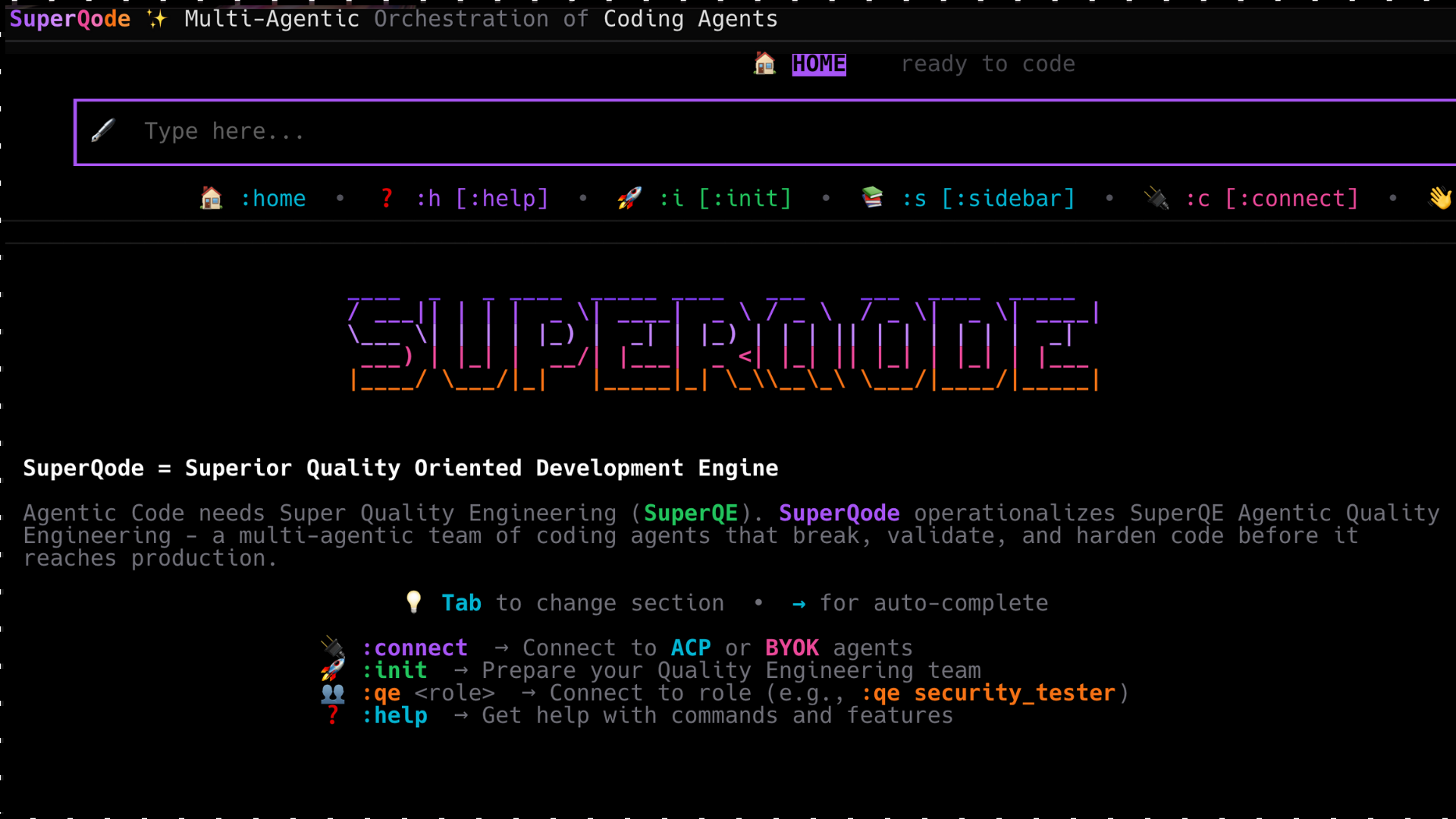
superqode
Headless coding harness
cd your-project
superqode --print "inspect this repository and suggest the smallest next step"A harness is the repeatable contract for how an agent run behaves. Start with the default coding harness:
cd your-project
superqode harness init my-coder --template coding --output harness.yaml
superqode harness doctor --spec harness.yaml
superqode harness run --spec harness.yaml --prompt "summarize the architecture"
Prefer to start from a complete file? See examples/harnesses for ready-to-run specs covering builtin, no-tool, PydanticAI, DeepAgents, OpenAI Agents SDK, Google ADK, Gemma4, and DS4.
After a run, inspect what happened:
superqode harness events <run-id>
superqode harness graph <run-id>
superqode harness graph <run-id> --json
Use doctor before sharing a harness with a team. It checks backend availability, spec compatibility, sandbox policy, event-store readiness, approval support, MCP config paths, and rich event graph support.
| Goal | Start with |
|---|---|
| Let SuperQode edit, search, and run shell commands under policy | superqode harness init app --template coding |
| Bet on model capability without tools or repository access | superqode harness init reasoner --template no-tool |
| Optimize for local Gemma4 coding | superqode harness init local --template gemma4-coding |
| Optimize for fast DS4 local iteration | superqode harness init fast --template ds4-fast-local |
Install only the runtimes you need:
pip install "superqode[adk]"
pip install "superqode[openai-agents]"
pip install "superqode[deepagents]"
pip install "superqode[pydanticai]"
Then select a backend in a spec or at run time:
superqode harness run --spec harness.yaml --runtime pydanticai --prompt "review this design"
superqode harness run --spec harness.yaml --runtime openai-agents --prompt "make the smallest safe fix"| Feature | Description |
|---|---|
| HarnessSpec | Define coding, no-tool, local-model, and custom harness behavior with one declarative contract |
| Harness runs | Run sessions with normalized events, run records, typed outputs, and workflow execution |
| Pluggable runtimes | Swap the agent loop: SuperQode native, Google ADK, OpenAI Agents SDK, optional DeepAgents, or optional PydanticAI |
| Event graph | Inspect model, tool, approval, sandbox, subagent, memory, and result events across supported runtimes |
| Harness doctor | Preflight backend installation, spec compatibility, sandbox policy, MCP config, approvals, and graph readiness |
| Developer TUI | Interactive sessions with wrapped prompts, quiet streaming logs, compact tool activity, and readable change summaries |
| Headless CLI | Run coding tasks and provider checks from scripts or terminals |
| Tool system | File, search, edit, shell, todo, MCP, and optional Monty Python REPL tools |
| Sandbox contract | Use local sandbox policy for read, write, shell, command, grep, glob, and edit access |
| Typed outputs | Ask a harness run to return validated structured data using explicit result delimiters |
| Workflow engine | Run single, chain, parallel, router, orchestrator, and evaluator-optimizer workflows |
| Model policies | First-class Gemma4, DS4, coding, and no-tool policy profiles for local and hosted models |
| Provider UX | Provider doctor, model listing, guided local provider selection, and dynamic OpenCode free model discovery |
| Harness flavors | Tool-rich coding and model-only no-tool profiles, with room for Bring Your Own Harness specs |
HARNESS LIFECYCLE
━━━━━━━━━━━━━━━━━
1. SPEC       Choose coding, no-tool, local-model, or custom harness behavior
2. MODEL      Resolve policy for Gemma4, DS4, hosted models, or model-only runs
3. RUNTIME    Run on builtin, OpenAI Agents, Google ADK, DeepAgents, or another backend
4. TOOLS      Attach file, search, edit, shell, MCP, or no tools
5. SESSION    Stream events, persist history, compact context, and store runs
6. OUTPUT     Return text, typed data, workflow results, and validation state
The default coding harness keeps repository work practical. The no-tool harness lets you bet directly on model capability. Optional runtimes let teams bring their preferred agent framework without replacing the SuperQode harness contract.
SuperQode normalizes runtime-specific streams into one harness event graph:
| Backend | Rich graph events |
|---|---|
builtin |
Model requests, model deltas, tool calls, tool results, approval pauses, final results |
pydanticai |
Model deltas, tool calls, tool results, final results, approval pauses |
openai-agents |
Model deltas, tool calls, tool results, approval pauses, sandbox markers |
deepagents |
Model deltas, tool calls, subagent activity, memory reads/writes, sandbox file/command events, final results |
adk |
Run and stream events with the same graph storage contract |
This gives teams one way to debug runs even when they use different agent frameworks.
For complete guides, configuration options, and API reference:
We welcome contributions! See CONTRIBUTING.md for guidelines.
git clone https://github.com/SuperagenticAI/superqode
cd superqode
uv pip install -e ".[dev]"
pytestApache-2.0 - Built by Superagentic AI for developers who care about code quality.